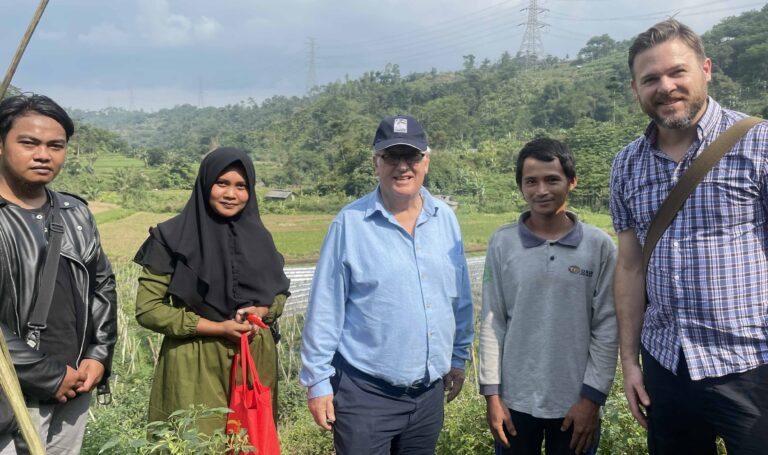
Since 2020, Good Return Gave $5+ Million in Loans to over 600 Women-led Businesses. Here’s Why I’m A Proud Partner.
Although it's been more than decade since his passing, his influence and teaching have rubbed off on me.
Read more

I was born and raised in Australia.
A country that has granted me many privileges.
I’ve gone through a quality education system that’s allowed me to become a lawyer with no debt. I entered a thriving job market, which gave me steady employment. And a fair and inclusive economy that allowed me to open my first legal practice in Carlton.
These are privileges many don’t have.
But I’ve also seen how quickly things change on an international scale.
Both for good and bad. Not just in Australia but in neighbouring countries.
Globally, the world faces complex challenges like climate change and rising inequality. But our closest neighbours, like Timor-Leste, are experiencing these challenges on a more complex level.
We cannot sit back and watch. We need to support them.
Here’s why.
It’s no secret our economy relies on fossil fuels.
91% of our primary energy consumptioncomes from coal, oil and gas.
Our government has committed to net zero greenhouse gas emissions by 2050.
But our fossil fuel dependence continues to rise.
It’s the same for countries like Timor-Leste.
Blessed with natural resources but dependent on one industry to drive their economy.
The only difference is Australia has been able to diversify its economy through resource wealth, a strong services sector, and global trade integration. For the young nation of Timor-Leste, this has been a challenge.
The country struggles with an aging political class, weak infrastructure, and workforce development challenges.
Combine this with limited access to the global markets, it’s a big national problem.
This creates a serious challenge to diversification and long-term economic sustainability.
This is often referred to as a ‘resource curse’.
When I made my last trip to the country, I spoke to the president of Timor-Leste, José Ramos-Horta who shared his concerns.
The country is walking a delicate tightrope.
Balancing between economic needs for their growing nation with environmental responsibilities.
Fossil fuel revenues make up over 90% of the country’s government income. This is vital for their survival as a country.
It’s their largest export.
It funds their schools, hospitals and infrastructure.
But they also realise it’s not a long-term sustainable model.
While they cannot rely on fossil fuels forever, they currently don’t have any other significant alternative sources of income.
Parag Khana, author of “The Future is Asian”said it best.
“The challenge is not simply to grow but to grow in ways that ensure sustainability, equity and peace for all its people”.
This is why the country and more importantly, its people need help.
And it’s more than just financial aid.
They need expertise and infrastructure to support their transition away from unsustainable resources like oil dependency.
It is laudable that just before Christmas last year the Prime Ministers of Australia and Timor-Leste released a joint statement. In this statement it was announced that;
To support Timor-Leste’s wishes to secure long-term economic growth, improve living standards and diversify its economy, Australia has proposed to make a significant investment in Timor-Leste’s future through the establishment of a dedicated infrastructure fund, capitalised from part of Australia’s share of future revenue from the Greater Sunrise project.
It is my hope that this fund, along with other initiatives help Timor-Leste truly transition to a more environmentally sustainable economy.
We must remember we don’t just have an environmental responsibility but a moral one.
What happens to our neighbours, also affects us.
I recall having an emotional conversation with a local leader, Simao during my visit in Timor-Leste.
He questioned whether Australia truly understood the gravity of their situation.
He had a sense of urgency in his voice. They were caught in a painful dilemma.
They could either continue to rely on fossil fuels revenues to fund vital services like healthcare, education and infrastructure. Or they could commit to transitioning to renewable energy sources and jeopardise providing these essential services.
And that is in a country where nearly 50% of the population live below the poverty line.
He feared without international support, the country may be forced to choose between short term survival and long term sustainability.
The stark reality is these transitions cannot be made alone.
The leaders I spoke with felt deeply frustrated. They knew what was needed but were unsure how to get there.
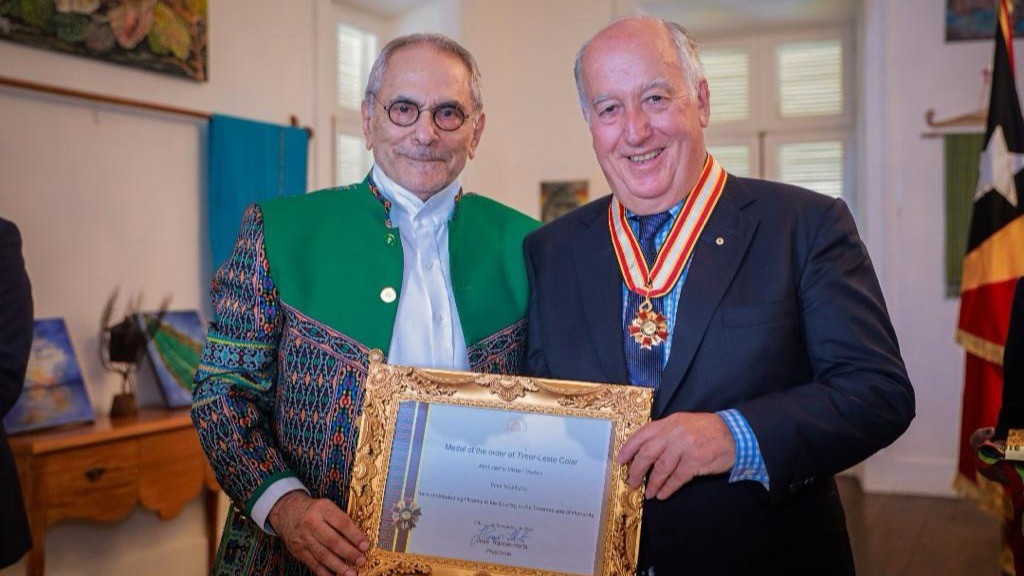
In 2023, I had the honour of being awarded a Timor-Leste medal(Collar of the Order of Timor-Leste) for my substantial commitment to Timor-Leste for over more than 20 years.
I felt deeply humbled.
This recognition deepened my understanding of the need for international collaboration. In my acceptance speech, I spoke about the power of partnership, collaboration, and trust. It was touching to see the room full of delegates, representatives and government officials nodding along.
When you’re surrounded by people with the same mission as you, progress happens.
Global solidarity is crucial.
Our partnership is not just an opportunity but a responsibility.
They can’t do it alone.
Transitioning to a sustainable economy is a huge task.
No single nation can achieve it in isolation.
As CACCI President, I remember talking with the former Australian Ambassador to Timor-Leste, Peter Roberts. We agreed on the importance of collaborating together to tackle these challenges on a micro level first.
This is why I started the Good Business Foundation.
My team and I aim to support purpose-driven and sustainable businesses in communities that need them. For example, last year together with the Australian Government we supported a project to support women led growth stage businesses.
The purpose of this project was two fold;
First was to directly support these women who had built their business to a point where they needed business coaching, mentoring and networks to sustain and maintain their businesses. Without such support there was a high risk that their businesses would flounder and fail.
Secondly we were interested in understanding what policies and support may be needed for these types of businesses to be more of the mainstream rather than the exception. The thing is we could start writing a whole range of policies, or offering a number of capability training opportunities. But to understand what is first needed by these women will be critical to a continued and sustained program of support for these women.
A program that my Good Business Foundation hopes to continue with the Australian Governments.
The transition is like that African proverb; the only way to eat an elephant is one bite at a time.
The future of Timor-Leste depends on how we respond.
I was having dinner with my GBF co-founder Stuart.
We discussed our renewed strategy for 2025, which focuses on fostering cross-country collaboration, particularly supporting Timor Leste’s pursuit of a more diversified and sustainable economy.
Last year, we convened a dinner of like-minded individuals from across my network to explore ways to help Timor-Leste’s economic development moving forward. I now call these ‘Good Business Gatherings’.
I’m excited to see these conversations turn to action.
The challenge for Timor-Leste economy is not a distant issue.
It also impacts us in Australia.
Economic hardship, resource scarcity and social unrest in our neighbouring countries can spill across borders as people move for better opportunities.
The world is an interconnected community.
Supporting our neighbours isn’t just about providing aid.
It’s about safeguarding the stability and prosperity of the entire region.
What happens to one. Impacts all.
Till next time,
Peter.
P.S – If you want to receive exclusive updates on business trends, philanthropy and the future of work, sign up to my email list: HERE.
Although it's been more than decade since his passing, his influence and teaching have rubbed off on me.
Read more
Although it's been more than decade since his passing, his influence and teaching have rubbed off on me.
Read more
Although it's been more than decade since his passing, his influence and teaching have rubbed off on me.
Read more